
Uzbekistan
Travelogue

Central Asia is a strange place. It sits at the crossroads of old trade routes. Goods, ideas, religions, peoples drift through like migrating winds. The region is layered in deep sediments, spiritual and geological alike—cultures, tongues, lineages, long dead and still living, overlaid and mixed into an impossible synthesis. Nomads, Greeks, Turks, Mongols, Persians, Russians, Soviets. Histories compacted into a single, sun-scorched expanse.
I’m still not sure what pushed me toward Uzbekistan. One reason is obvious: family history. My father served in the Soviet Air Force and spent a few years on a base near the Afghan border. He has that rational, almost mechanical mind common to men of his generation, but one incident broke through his materialism.
He dreamt he was standing in that Martian desert. The heat pressed on his skull. Across the yellow haze, Afghan soldiers raised their AK-47s. They fired. He ducked—and woke up drenched.
A few days later the scene repeated itself. He and his comrades were in the desert; Afghans appeared; he shouted for them to get down just as the shooting began. The dream had gone ahead of reality.
The other reason for my trip is less intelligible. Decisions crystallize before thoughts fully form. One day I simply realized: I was going.
I arrived in Tashkent in the middle of the night. The prayer in Arabic at takeoff had already shifted the ground under me. As I exited the plane, long lines of Uzbeks in traditional white dress stood before passport control, pale and granular as rows of sugar. After a brief exchange in Russian with the border guard, I stepped outside.
A taxi driver materialized immediately. Insistent, tireless, he followed me around. At this point, too exhausted to resist, I let him drive me, though every instinct of mine was wary. He cycled through the usual offers: city tour, Samarkand, “special price.” Later I’d learn this is simply the staple of taxi drivers here and of merchant cultures more generally.
I reached the hostel on the outskirts, and to my relief the reception was open at 4 am, though the receptionist himself was nowhere to be found. A shape was sleeping on the couch opposite mine. An alarm rang every five minutes. The shape would promptly turn it off and go back to sleep. This repeated thirty times, probably more. Eventually, I drifted off myself.
After a short but restful nap, I checked in and walked toward the center.
The district—like most of Tashkent—felt unmistakably Soviet. The earthquake of ’66 had leveled the old city, and the reconstruction gave it the familiar post-Soviet geometry. Massive blocks stood in disciplined rows along immense boulevards tracing through the city, with narrow pedestrian passages winding between them and courtyards with gazebos and playgrounds at their center.
Reaching the heart of Tashkent, I was struck by the sheer openness. The city feels like an outstretched palm. Monumental Soviet-modernist buildings flank the boulevards; the sidewalks too are wide, shaded by long rows of trees. And everything is clean—unnervingly clean. Every morning, municipal workers and merchants sweep away dust and fallen November leaves with ritual discipline. I paused to watch them.
Samarkand felt like stepping into a deeper historical stratum. The Registan’s blue-tiled facades and the dense, obsessive geometry of Timurid ornamentation pulled the eye inward. Inside the mausoleum, a rhythmic prayer in Uzbek echoed against the tiles, folding the space, and me with it. There were few tourists. I spent most of my time walking and reading. On the outskirts, ruins—half-eroded, half-erased—opened into silence.
Ruins. What do they say?
They speak the mercilessness of time.
As I step on stone and sand I almost hear the vanished bustle—
but it is just vibration under the dry crunch of my foot.
Now, only the silent come.
There flies a black feathered bird, touched by blue on the tips of its wings.
What draws it? Perhaps it hears something I don’t.
I feel no heaviness. These ruins feel nothing.
Their indifference is tender. Time left them like this.
I lift a dusty stone wedged in the ground.
It has left a small scar. Who knows how long it lay there.
I return it with care, letting its shape settle back into the earth.
The disturbance closes.
I left the ruins. From Samarkand I took the train west toward Bukhara. It cut through reddish-brown desert and low settlements until the city appeared.
Bukhara was my favorite: dense medieval streets, domed buildings the color of unbaked clay. The place, sand-toned and sun-bitten, looked like Tatooine. Cats with improbably thick fur roamed the streets; some leapt into my lap, two at a time, or perched on my shoulders to watch the passersby. The food was simple: meat, mostly. Shashlik, plov, endless green tea. Pickled salads. I ate well.
Khiva had the same desert-walled feel as Bukhara, but more carefully kept. Inside the old city, merchants tended long rows of stalls selling Uzbek goods: tyubeteykas, embroidered dresses, camel-fur socks, small trinkets laid out on cloth. Local tourists moved from stall to stall, bargaining without haste. Wedding processions drifted through the narrow streets, young men and women dancing to music from small speakers. Further in, beyond the market line, I found rows of clay houses. People still live here.
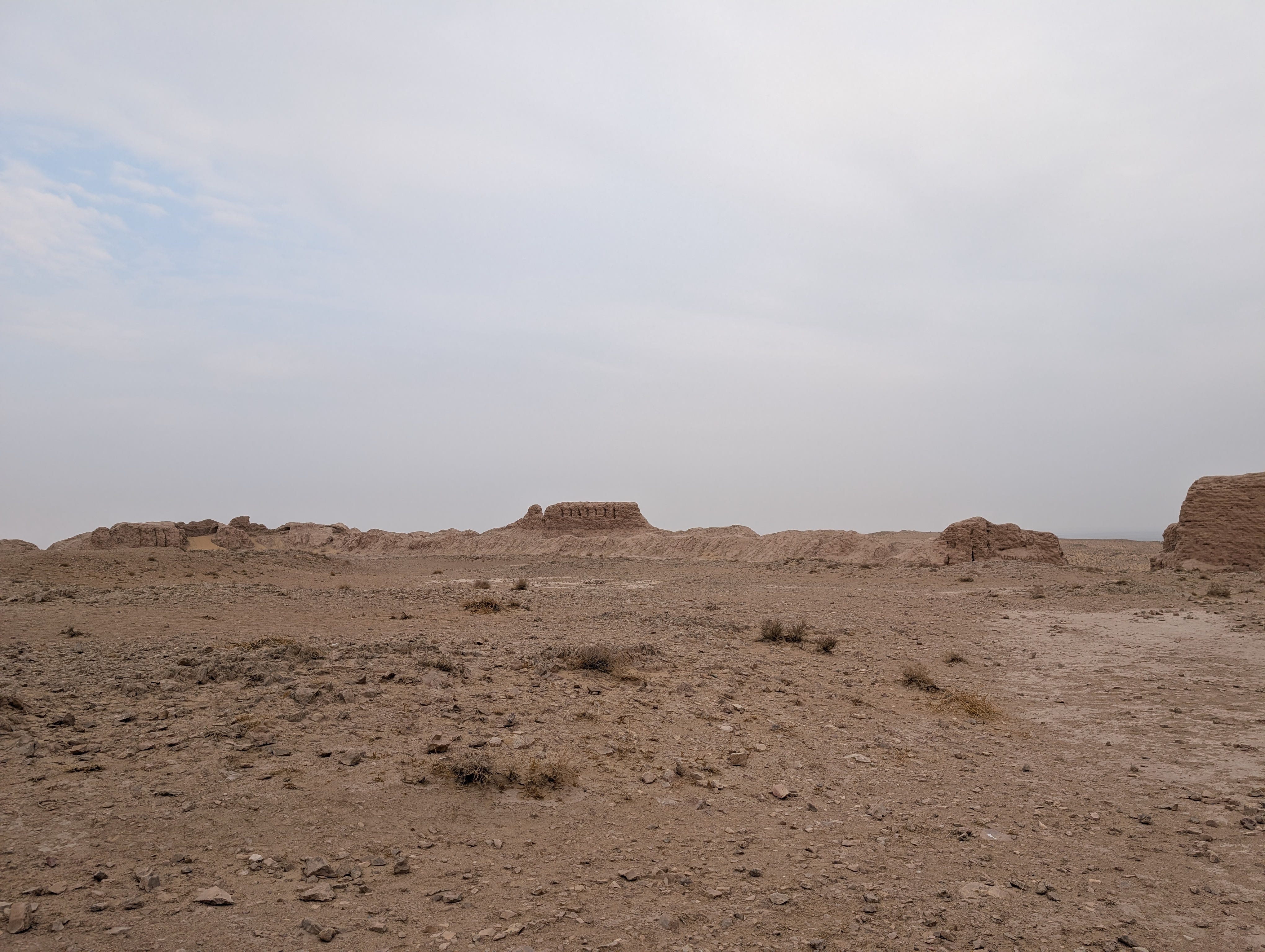
Outside of Khiva, scattered fortresses, half-collapsed, punctuate the dusty landscape. Their walls crumble into nothing upon touch. They shouldn’t still be standing.
The people are pleasant, though not expressive. It took me some time to adjust and mirror their restraint. I myself was watched like a specimen—pale and blonde against their darker features. Children would run up to me with curiosity sparking in their eyes, wondering where that stranger came from. The Steppe has flattened phenotypes over centuries; faces here feel shaped by wind and long distances. The country is young—visibly so. Students everywhere, especially in Tashkent and Samarkand. Dozens of new universities have opened in the last decade, drawing people from Pakistan, India, China, Kazakhstan.
But poverty shadows everything. Money came up in nearly every conversation: the cost of phones and cars abroad, salaries, whether life really is better “over there.” Uzbekistan feels isolated. It is oriented mostly toward Russia; the wider world recedes. Many men wait on visas for seasonal work abroad: construction in Moscow, farm labor, berry picking in the UK. The country finds respite from tension only through these migrations.
In the cities, though, a different pressure gathers. New malls, glass towers, and universities rise faster than the wages that build them. The place feels like a bow drawn back—held, waiting for direction.
Uzbekistan remains distant in ways no visitor can close. Everything lies near the surface, yet nothing yields. The wind lifts the dust. The layers settle again.
Caught in between history itself